Dr. Louisa Lombard is an anthropologist at Yale who has worked for over twenty years in the Central African Republic, particularly in the far Northern regions, studying the socipolitical realities of the conflicts therin. I wanted to speak to Dr. Lombard because I was struck by her capacity to write about Central African politics in a clean yet precise manner. Moreover, I admire her framework of sovereignty triangles, to describe C.A.R’s relationship with France (and the West broadly) and Russia. While I knew from reading her work that she is less focused on global health, I still valued her insights and figured she would be attuned to those topics. Here then, is my conversation with Dr. Lombard.
SM: When was your last trip to C.A.R.?
LL: My last trip was in late November, 2023.
I spent time hanging out with Rwandan soldiers in C.A.R and Mozambique. There, we had some contact with Wagner soldiers, and we went to some ceremonies where Wagner was there, such as at a graduation ceremony. They were passing out (awards?) for new recruits into the armed forces. The [Central African] president had Rwandan and Africa Corp guards sitting close together [in the arena] but doesn’t open with it in an explicit way.
Then, before that, I had a trip in November 2021.
I spent time in Bria [town, 2 hours flight from Bangui) with Rwandan Soldiers to temporarily open a base. They were two hours’ drive to the base with Wagner forces, who questioned them with pretend questions.
SM: What are some major differences between how Wagner is affecting the country versus the former conflicts starting in 2013?
LL: Well, I don’t know if food security or health impacts are different now, although the level of intensity of armed violence is different. The fact is that ¼ of C.A.R’s population is displaced at any given time. People live in fields or villages. It is different on who is displaced but this all affects food security. Scandals of politics that there is so much widespread hunger in the region. Humanitarian organizations will change food security guidelines to try to gain access to aid. This insecurity is an unnecessary tragedy upended by conflict. Policies are limiting access to foraging. There is overall uncertainty and displacement.
SM: Can you describe any experiences you’ve had visiting or interacting with health services in C.A.R?
LL: Well, first of all, there aren’t a lot of state health services. But MSF [Médecins Sans Frontières] and NGOs are there.
Since 2003, Enrica Picco (International Crisis Group Project Director for Central Africa, wrote a chapter in the 2015 Making Sense of the Central African Republic book that I am one of the authors of). There, Picco developed the concept of the humanitarian accordion.
That refers to how, during acute crisis, the level of aid people receive increases, and then the aid decreases after crises die down. There are no sustainable institutions.
I knew two Central African women who died during childbirth. They were both well-educated. One was in Bangui, and she died of hemorrhage in 2010. The other was some year before that, in a rural area in the Northeast. And then I also knows a researcher who died of malaria.
SM: What are any notes you have regarding how the Anti-Balaka conflicts versus Wagner mercenaries have affected health in the region (northeast and Bangui)?Food insecurity is discussed in your Sovereignty Triangles piece. What do you know about the sexual assaults occurring at the hands of Wagner in women’s fields? Fulani targeting?
LL: I’m not personally aware of instances but I believe and imagine there’s assault happening. Mainly, Wagner does events of public torture to install fear in the population. There are Africa Corp forces from all over, many from other conflict zones that Wagner works in. I can recommend John Lechner’s book (Death Is Our Business: Russian Mercenaries and the New Era of Private Warfare) which details that many Wagner fighters are from Syria, Libya, etc.
Furthermore, Wagner has no professional hierarchy or discipline. Rwandans say that Wagner are mercenaries with no chain of command.
Africa Corp’s people purposefully open and stage in places of the country where its tricky for journalists into. When the journalists do try, the [Central African] government will start attacking them, labeling them as disinformation campaigns. The UN should function as overseers, but their ability is compromised. There are past reports on abuses by Wagner.
There are also UN Expert Reports. These are political but it is difficult to figure out what to say, what you can say or what will happen to researchers/the UN as a whole and any others. Natalia Dukhan “Enough Project” did a report on Wagner in mining areas.
SM: Do you know of any initiatives in C.A.R that are like City of Joy in Congo? Rape Relief/women’s healing centers?
LL: No, not that I know of. For historical reasons, there is an idea of “civil society” in Congo that is robust and well developed. The density of that is lower in C.A.R.
I know about OFCA (a Central African women’s org). Ndele (a woman who was the head OFCA at one time) was dynamic and she went to every political and community event to be visible
SM: Have you spent time in hospitals and clinics in the northeast or Bangui or anywhere else? Describe it.
LL: Again, I have not spent much time in hospitals or clinics. In Tiringoulou, there is a clinic run by IMC [International Medical Corps], an American NGO. I was friends with a Central African doctor there. Perhaps he wasn’t a real doctor, but more like a physician’s assistant. Anyway, he did operations and c-sections, not always with painkillers. I was just there as a bystander, not investigating.
SM: Do you have knowledge/opinions around the various NGOs or projects that claim to support women’s empowerment, or health in general?
LL: The environment for research that’s considered political is tough. Although there is political research being done, the ICG won’t go to C.A.R for the time being. There is a Belgian Portuguese researcher that has been held in prison for one year in Bangui and will be there for the time being. His name is Martin Joseph Figueira (news story).
SM: How much of an issue is AIDs at this point? Are people able to access meds to manage it? Russia currently has high rates of HIV. (recruiting people with HIV to fight, red wristbands).
LL: I can point you towards Pierre Marie-David, a Montreal researcher who wrote his dissertation on HIV in C.A.R. This research was done 15 years ago. The survey on HIV and AIDs in C.A.R found that by far, the highest group of infection was well educated women (25%) far higher than military men. Why is that? It indicates possible dynamics of women ending up in and maintaining their place in a man’s world.
SM: Lastly, can you speak to any changes you’ve seen over the years in regards to tourism?
LL: Tourism has decreased dramatically. What has managed to stay, some tourists will go [I reference the Europeans I saw in at Dzanga-Sangha lodge in Bayanga].
There used to be safari hunting tourism. There was a lodge owned by Charlotte Mararv’s brother Eric that employed 300 people (not year-round but still). It is bad that that’s over because the country shared revenues with the local population. Rebel groups have made it too dangerous for people to go.
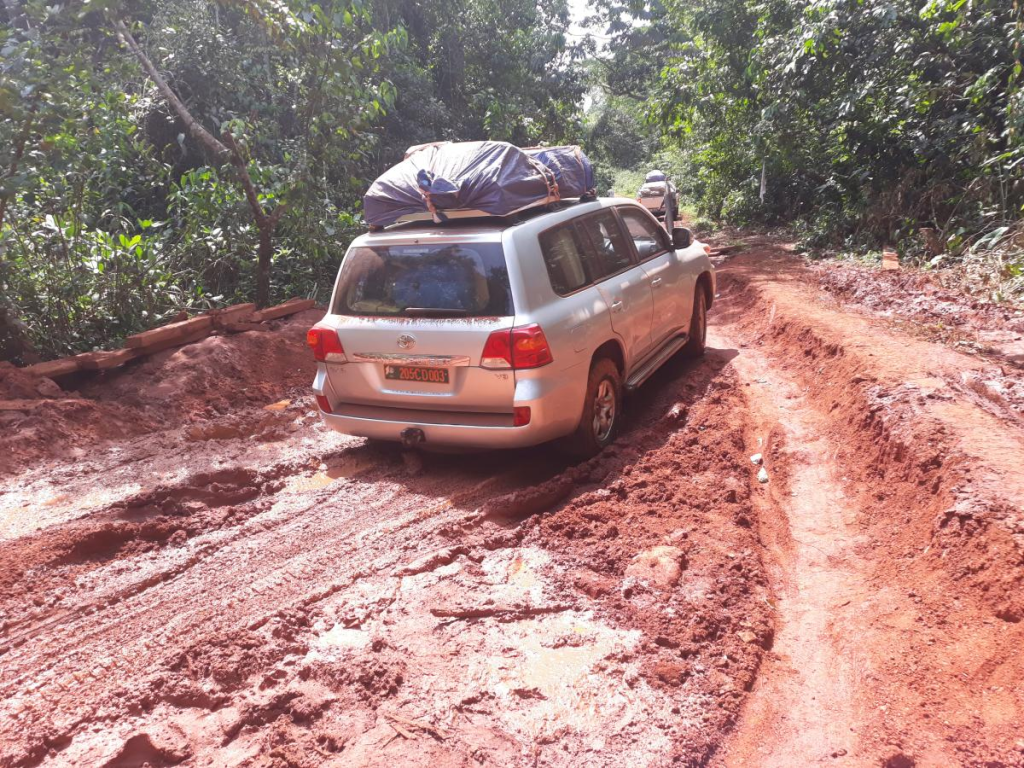
SM: I wanted to tell you more details about my C.A.R. trip in 2022, which was my first time in the country. After being at Dzanga-Sangha for about 10 days, we were set to head back to Bangui. While we were set to travel back by plane, the purchased jet fuel appeared to be missing. So, my parents arranged for a car and driver to take us down the long treacherous journey.
What ensued was a hilarious saga. My parents insist that this journey, a 507 km distance, used to be an 8 hour trip, when the roads were better. Google curiously claims it’s an 11 hour journey. In actuality, twenty years into the future, it was a twenty-three hour ordeal, with the road more like a mud pile ditch. This picture from an ICC article (The Road to Boda) is an excellent depiction of the route.
Health came up on the trip, as the hired driver had a nose bleed. While we stopped in a little town to have a Coke and get some gas, the driver apparently received an IV, I assume to get his fluids up. Still, knowing what I know, there is certainly a risk of contracting HIV or other blood borne diseases through the needle.
Further on, we were questioned by a policeman in his office, who really just wanted to beg a ride off of us, and saw several roads completely gutted and decimated by Wagner, forcing us to reroute. When we passed into Boda, a mining town, it was dark by then, but the place felt eerie behind that, as my mother told me tales of prostitution and crimes related to the mining. We were frustrated now, as Bangui has a curfew restricting cars to travel past the checkpoint after a certain time in the evening, and we were nowhere near making that time.
After crossing through a creek (the only time I felt fear), we resigned to staying the night in a hotel in Mbiki. In the morning, we were able to drive into Bangui.
 SantÉ Ti Wali